


ACL Injury Treatment in Pallikaranai: Symptoms, Recovery, Physiotherapy & Surgery Guide


Reviewed by
Dr. Kanaga Lakshmi, MPT(Ortho)
Founder & Chief Physiotherapist,
Stability Physio Care 15+ Years of Clinical Experience in
Orthopedic & Musculoskeletal Physiotherapy
Sports Rehabilitation & Spine Care Specialist
Celebrity Sports Physio
Last Updated: NOV 2026
Introduction
Knee injuries can happen to anyone. Whether you're a football player, office employee, homemaker, college student, gym enthusiast, or someone who simply slipped while walking, an ACL injury can significantly affect your mobility and quality of life.
At Stability Physio Care, ACL Injury Treatment in Pallikaranai, we help patients recover from ACL injuries through personalized physiotherapy programs focused on pain relief, strength restoration, knee stability, and safe return to daily activities.
What Is an ACL Injury?
The Anterior Cruciate Ligament (ACL) is one of the main ligaments that stabilizes your knee joint.
It helps:
Keep the knee stable during movement
Control twisting and turning motions
Support walking, running, and jumping
Prevent excessive forward movement of the shin bone
When the ACL is stretched or torn, the knee may become painful, swollen, and unstable.
Are ACL Injuries Only Seen in Athletes?
No.
Although ACL injuries are common in sports such as football, cricket, badminton, basketball, and volleyball, they also occur during:
Slips and falls
Stair-related accidents
Road traffic accidents
Gym injuries
Sudden twisting while walking
Workplace injuries
Recreational activities
This is why ACL injuries can affect people of all ages and activity levels.
Replace the Statistics Section with This Professional Version
What Does Research Say About ACL Injuries?
Research shows that ACL injuries are among the most common serious knee injuries worldwide.
The annual incidence of ACL tears in the general population has been reported at approximately 68.6 per 100,000 people. [mayoclinic...erpure.com], [bpb-us-e1....pmucdn.com]
Research estimates that approximately 100,000 to 200,000 ACL injuries occur each year in the United States, highlighting the significant burden of this injury. [mayoclinic...erpure.com], [bpb-us-e1....pmucdn.com]
Studies indicate that approximately 70% of ACL injuries occur without direct contact, often during sudden twisting, pivoting, landing, or deceleration movements. [simpledecider.com]
Female athletes may have a higher risk of ACL injury compared with males participating in similar sports, with several studies reporting increased relative risk. [pmc.ncbi.nlm.nih.gov], [pubmed.ncb...lm.nih.gov]
Neuromuscular training and structured injury-prevention programs have been shown to reduce ACL injury risk in athletic populations. [gitnux.org]
These findings highlight the importance of proper conditioning, early diagnosis, and structured rehabilitation.
Common Causes of ACL Injury
An ACL injury may occur when:
Suddenly changing direction
Twisting the knee while the foot is planted
Landing awkwardly from a jump
Stopping suddenly while running
Falling with a twisted knee
Receiving a direct blow to the knee
Being involved in a road traffic accident
Symptoms of an ACL Tear
Common symptoms include:
✅ A popping sound or sensation
✅ Sudden knee pain
✅ Rapid swelling
✅ Difficulty walking
✅ Knee instability
✅ Reduced range of motion
✅ Difficulty climbing stairs
✅ Feeling that the knee may "give way"
When Should You Seek Help?
You should schedule an assessment if:
Swelling develops within a few hours of injury
Walking becomes painful
Your knee feels unstable
You cannot return to normal activities
The pain is persistent
Your knee repeatedly gives way
Early assessment can help prevent additional knee damage.
Does Every ACL Tear Need Surgery?
No.
Many people recover successfully with conservative treatment and physiotherapy.
The need for surgery depends on:
Severity of the tear
Knee stability
Age
Activity level
Occupation
Sports participation
Presence of meniscus or cartilage injury
When Is ACL Surgery Usually Recommended?
ACL reconstruction may be recommended when:
✅ The ACL is completely torn
✅ The knee repeatedly gives way
✅ Significant instability affects daily life
✅ Associated meniscus injuries are present
✅ The patient wants to return to pivoting sports
✅ Conservative treatment fails
✅ Job requirements demand a stable knee
An orthopedic surgeon will help determine whether surgery is appropriate.
When Can ACL Injuries Be Treated Without Surgery?
Non-surgical management may be suitable when:
✅ The injury is partial
✅ The knee remains reasonably stable
✅ Daily activities can be performed comfortably
✅ Functional goals can be achieved through rehabilitation
Many patients achieve excellent outcomes through physiotherapy alone.
Physiotherapy for ACL Injuries Treatment in Pallikaranai
At Stability Physio Care Pallikaranai, treatment focuses on:
Stage 1: Pain & Swelling Management
Ice therapy
Compression
Knee protection
Gentle mobility exercises
Stage 2: Restore Knee Movement
Range-of-motion exercises
Flexibility training
Joint mobility techniques
Stage 3: Strength Building
Quadriceps strengthening
Hamstring strengthening
Glute strengthening
Core stability exercises
Stage 4: Balance & Stability Training
Proprioception exercises
Single-leg balance training
Functional movement retraining

Stage 5: Return to Activity
Walking progression
Running progression
Sports-specific rehabilitation
Return-to-work exercises
Patient-Friendly ACL Exercises
Important: Perform these exercises only after professional assessment and if advised by your physiotherapist.
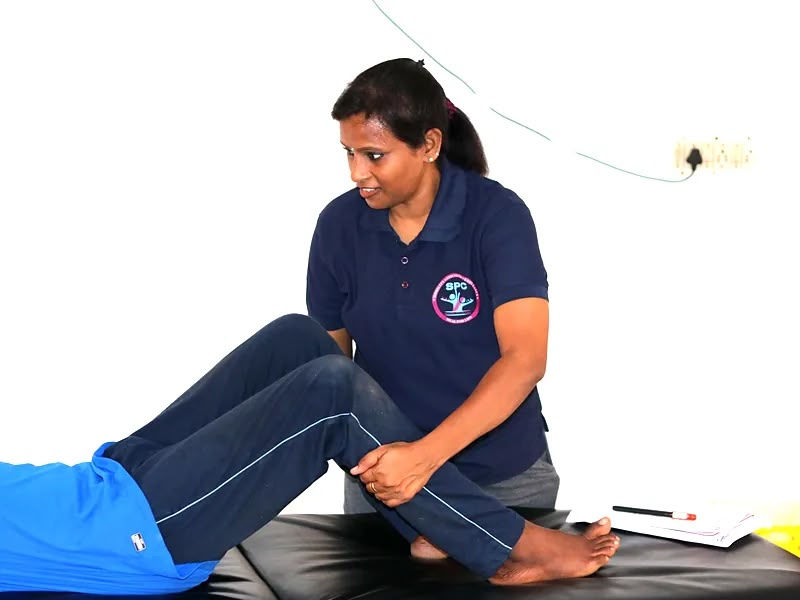
1. Quadriceps Set
Sit with your leg straight.
Tighten the muscles at the front of your thigh.
Hold for 5 seconds.
Repeat 10 times.
Benefit: Helps activate and strengthen the quadriceps.
2. Heel Slides
Lie on your back.
Slowly slide your heel toward your hips.
Return to the starting position.
Repeat 10-15 times.
Benefit: Improves knee bending mobility.
3. Straight Leg Raise
Lie flat on your back.
Keep one knee bent.
Raise the straight leg slowly.
Hold for 2 seconds and lower.
Benefit: Strengthens the thigh muscles without excessive knee stress.
4. Bridge Exercise
Lie on your back with knees bent.
Lift your hips toward the ceiling.
Hold for 3-5 seconds.
Lower slowly.
Benefit: Strengthens glutes and core muscles.

5. Single-Leg Balance
Stand near a chair for safety.
Balance on one leg for 15-30 seconds.
Repeat on both sides.
Benefit: Improves balance and knee stability.
Recovery Timeline
Recovery varies between individuals.
Typical recovery ranges include:
Minor ligament injuries: Several weeks
Moderate injuries: Several months
Post ACL reconstruction: Commonly 6-12 months or longer depending on recovery progress
Red Flag Warning Signs
Seek immediate medical attention if you experience:
🚨 Severe swelling
🚨 Inability to bear weight
🚨 Knee locking
🚨 Severe instability
🚨 Increasing pain
🚨 Signs of infection following surgery
Why Choose Stability Physio Care, Pallikaranai?
✔ Experienced physiotherapists
✔ Evidence-based rehabilitation
✔ Sports and orthopedic physiotherapy
✔ Post-surgical rehabilitation
✔ Individualized treatment plans
✔ Progressive exercise programs
✔ Patient-focused care
Whether your injury occurred during sports, a gym workout, a fall, or an accident, our goal is to help you recover safely and confidently.
Areas We Serve for Sports Injury Treatment
Pallikaranai
Velachery
Madipakkam
Keelkattalai
Kovilambakkam
Medavakkam
Sholinganallur
Perumbakkam
Internal Links
Chennai Pallikaranai Branch : https://www.stabilityphysiocares.com/pallikaranai-physio-care
Physiotherapy Services : https://www.stabilityphysiocares.com/services
Sports Ankle Sprain & Strain Treatment: https://www.stabilityphysiocares.com/post/sports-ankle-sprain-strain-treatment-in-spc-pallikaranai
Sports Injury Prevention in Pallikaranai: https://www.stabilityphysiocares.com/post/sports-injury-prevention-in-pallikaranai
Frequently Asked Questions (FAQs)
Q1. What are the symptoms of an ACL injury?
A: Common symptoms include knee pain, swelling, a popping sensation, instability, and difficulty walking.
Q2. Can an ACL tear heal without surgery?
A: Some partial ACL tears can be managed with physiotherapy, while complete tears may require surgical evaluation.
Q3. When is ACL surgery necessary?
A: Surgery may be recommended for complete tears, unstable knees, or patients wishing to return to high-level sports.
Q4. How long does ACL recovery take?
A: Recovery varies, but ACL rehabilitation may take several months. Post-surgery recovery often takes 6-12 months.
Q5. What are the best exercises after an ACL injury?
A: Common exercises include Quad Sets, Heel Slides, Straight Leg Raises, Bridge Exercises, and Balance Training.
Q6. Where can I get ACL physiotherapy treatment in Pallikaranai?
A: Stability Physio Care - Pallikaranai provides comprehensive ACL rehabilitation, post-surgical physiotherapy, knee strengthening, and sports injury rehabilitation programs.
🌐 ACL Rehabilitation | Knee Ligament Injury Treatment | Sports Injury Physiotherapy
Disclaimer:
This article is for educational purposes only and does not replace professional medical advice, diagnosis, or treatment. Please consult a qualified healthcare professional for an accurate assessment and personalized treatment recommendations.
Looking for ACL Injury Treatment in Pallikaranai?
If you have recently experienced a knee injury, swelling, instability, or difficulty returning to walking, exercise, work, or sports, early assessment can make a significant difference in your recovery.
At Stability Physio Care - Pallikaranai, our team provides comprehensive assessment, ACL rehabilitation, post-surgical physiotherapy, sports injury rehabilitation, and personalized exercise programs tailored to your recovery goals.
📍 Stability Physio Care - Pallikaranai, Chennai
📞 Call / WhatsApp: 98845 18846
🌐 Expert ACL Rehabilitation | Knee Ligament Injury Treatment | Sports Injury Physiotherapy
Book your assessment today and take the first step toward a stronger, more stable, and pain-free knee.


Excellent information about ACL injuries. The section explaining when surgery is necessary versus when physiotherapy can help was especially useful. Highly recommended read for anyone with knee instability.
Many people ignore knee pain after a fall or sports injury. This blog highlights the importance of early assessment and treatment. Great awareness article for the Pallikaranai community.
Very informative article. I didn't realize that not every ACL injury requires immediate surgery. The explanation about symptoms and physiotherapy was easy to understand. Thank you for sharing.
As a sports enthusiast, I found this guide extremely helpful. The recovery timeline and treatment options were explained clearly. Looking forward to more injury prevention tips.
Very helpful blog for anyone searching for ACL injury treatment in Pallikaranai. The information on symptoms, diagnosis, physiotherapy, and recovery was comprehensive and patient-friendly. Great work by Stability Physio Care.